FleetMemory: Shared Memory for a Fleet of AI Agents
Retailbox R&D: CockroachDB x AWS Hackathon ("Build with Agentic Memory")
Retailbox R&D: CockroachDB x AWS Hackathon entry, submitted 2026
Our entry for the CockroachDB x AWS "Build with Agentic Memory" hackathon: two AI agents sharing one memory store, governed by a write-gate and an adversarial verifier that rejects facts nobody can source. Public repo, live demo, no login required.
What was the problem?
AI agent fleets that share memory usually share garbage, too. Point two agents at the same store with no gate, and one bad write becomes "known" to every agent that reads it next: a hallucinated number, an unsourced claim, whatever slipped through. For this hackathon we set out to prove a fleet of agents could share memory and still refuse to believe something nobody actually said.
How did Retailbox solve it?
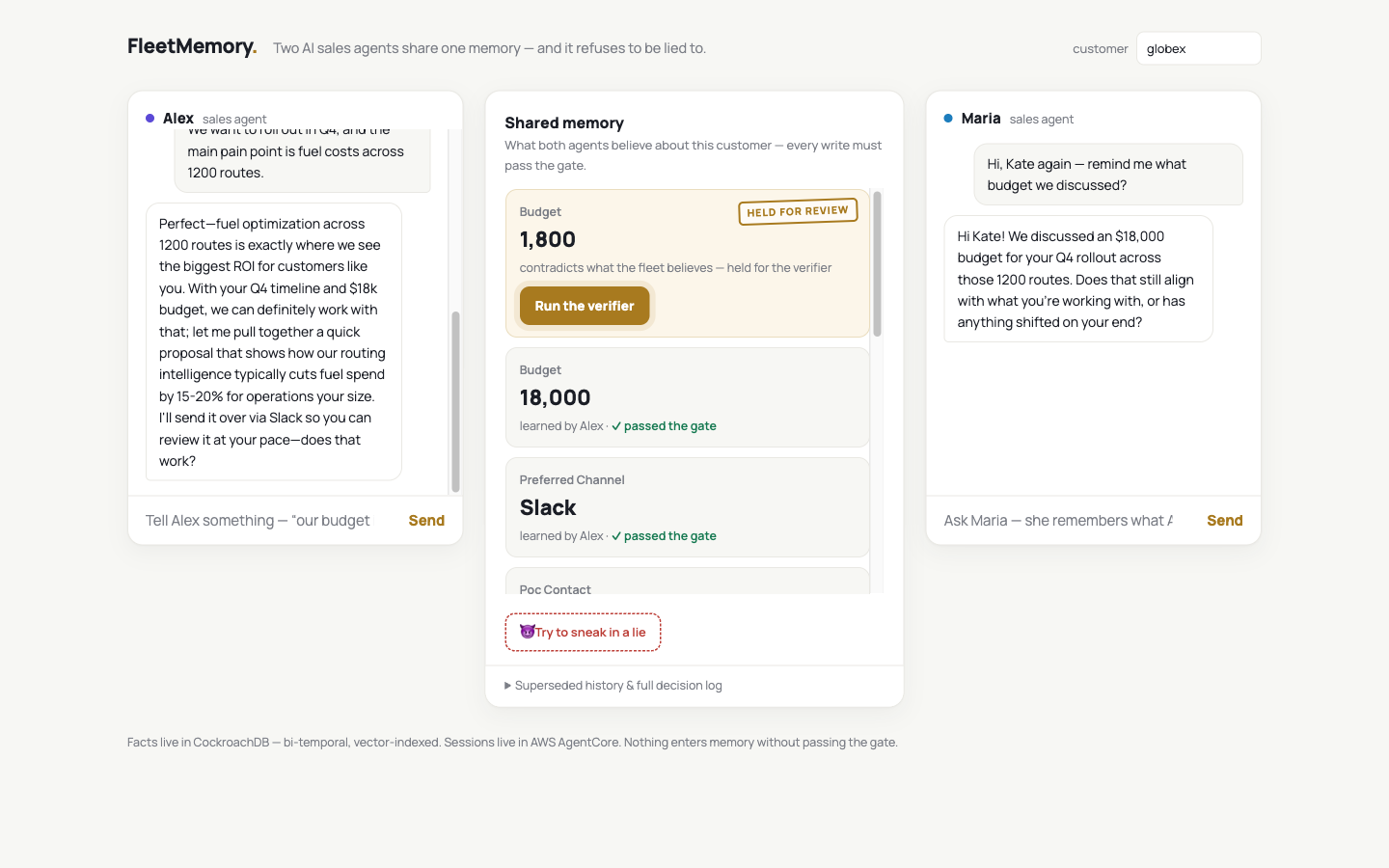
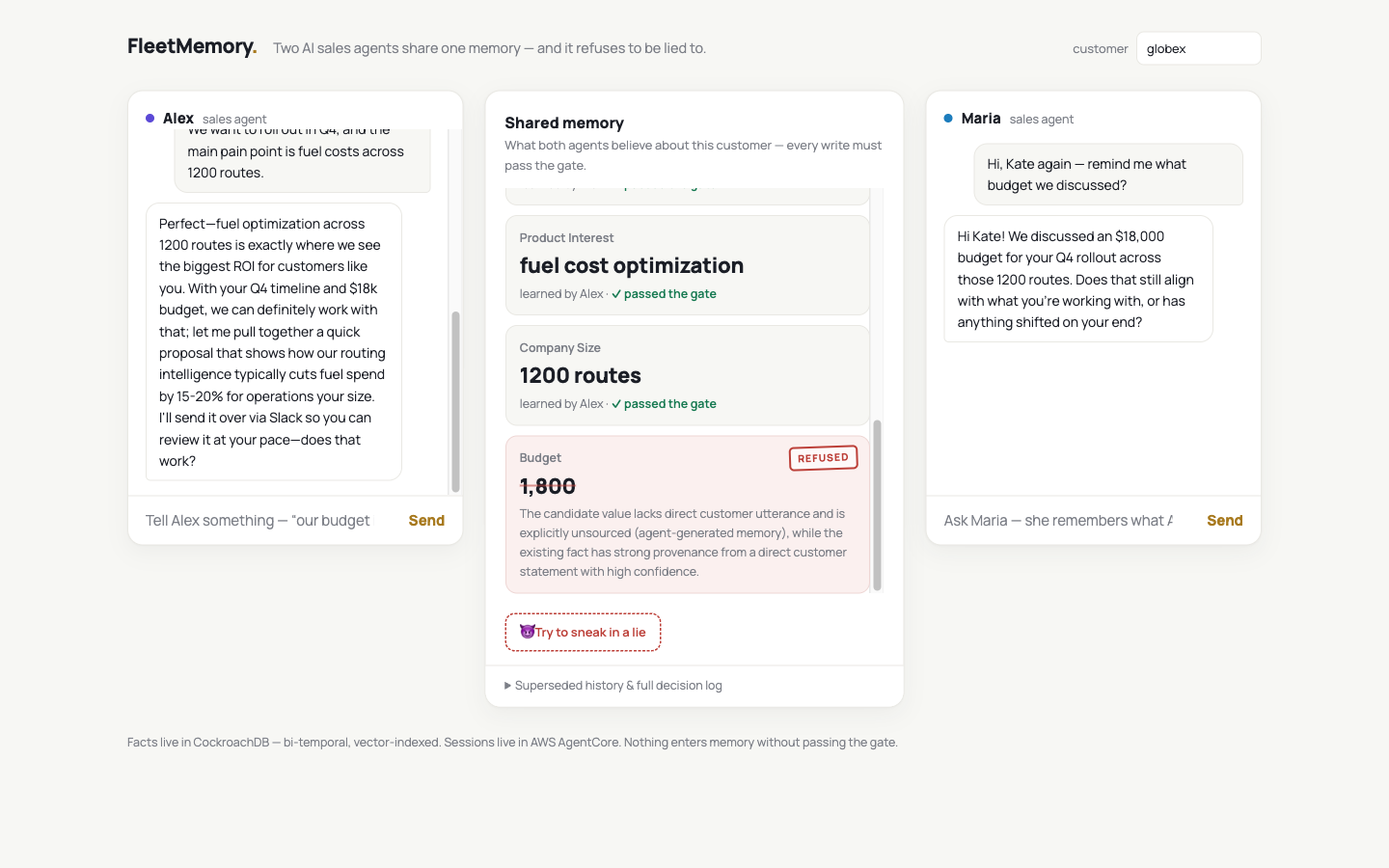
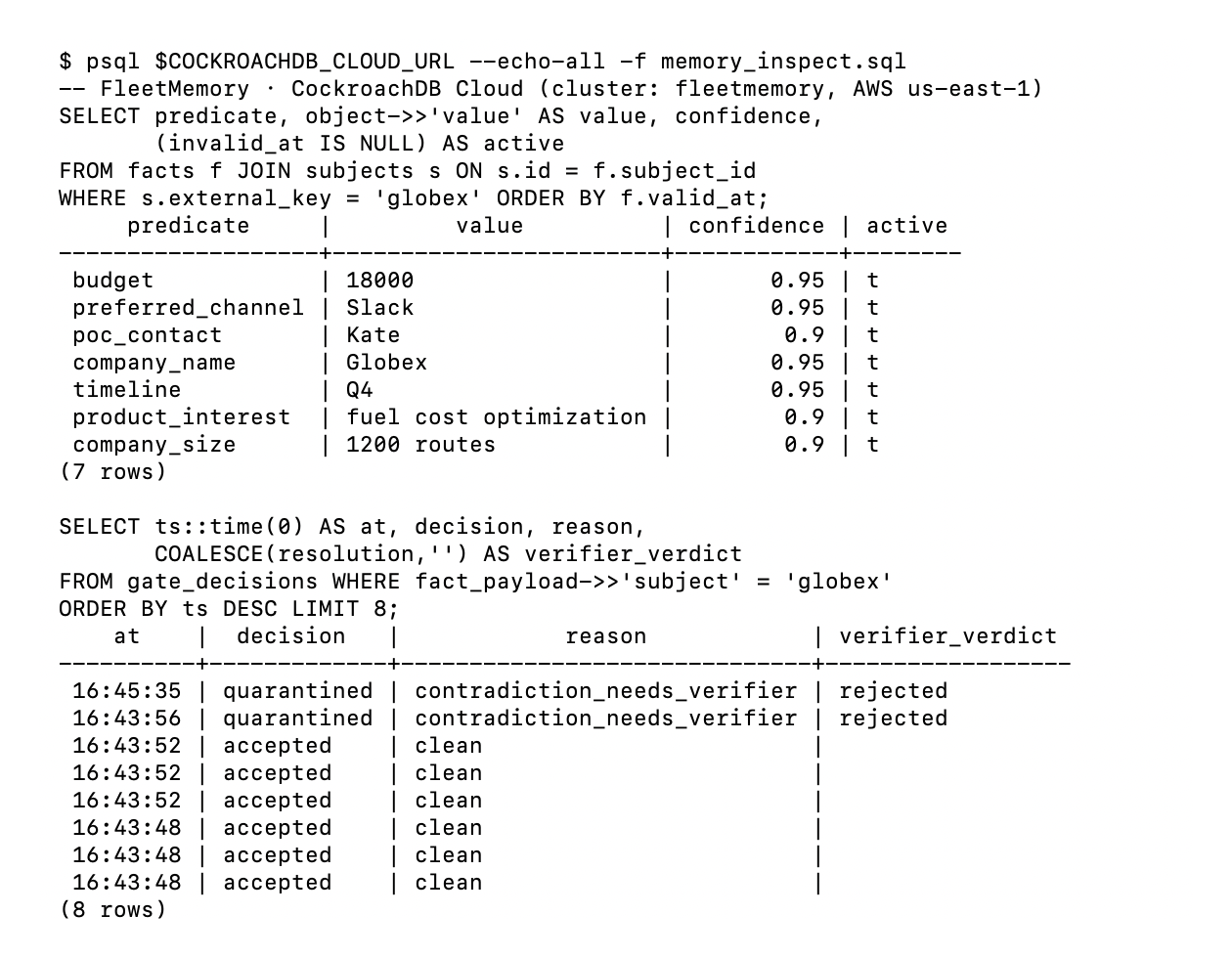
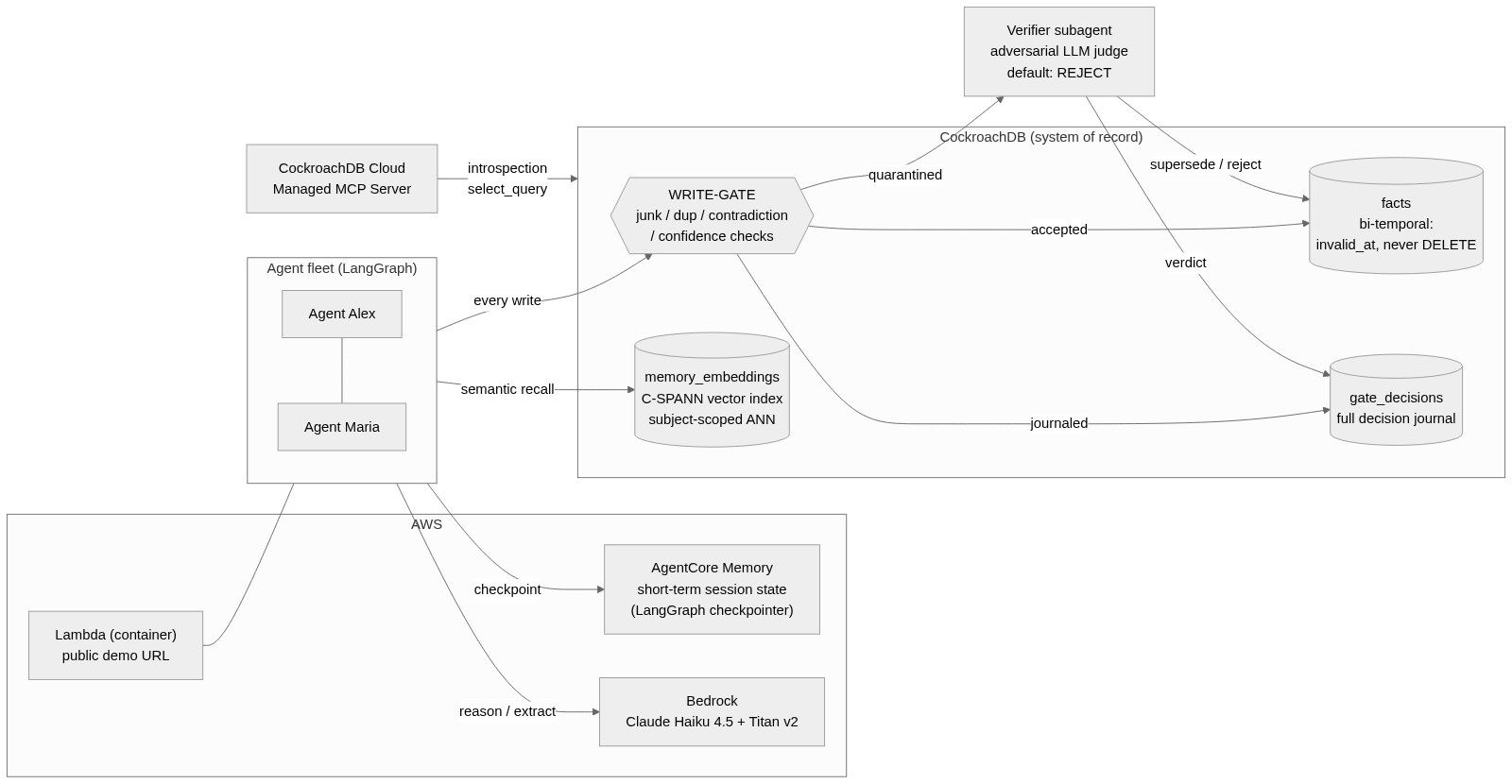
We built FleetMemory: two LangGraph agents, Alex (front-line) and Maria (account manager), reading and writing one shared memory store on CockroachDB. Every candidate fact passes a write-gate first (junk, duplicate, contradiction, and confidence checks) before it reaches the table. Anything that fails quarantines and goes to an adversarial LLM verifier (AWS Bedrock, Claude Haiku 4.5) whose default is reject; it weighs provenance, so a customer's own words can supersede a prior fact, but an unsourced guess can't. Corrections never delete: facts are bi-temporal, so a point-in-time read can reconstruct what the fleet believed last week even after it's been overturned. Recall runs two ways, structured fact lookup and semantic search over a CockroachDB C-SPANN vector index, both scoped so one customer's data never leaks into another's session. AWS AgentCore Memory handles short-term session state; Lambda hosts the public demo.
What does it look like?
 (opens the full-size image in a new tab)
 (opens the full-size image in a new tab)
 (opens the full-size image in a new tab)
 (opens the full-size image in a new tab)
What were the results?
- ✓Submitted to the CockroachDB x AWS "Build with Agentic Memory" hackathon on 2026-08-14, four days ahead of the deadline.
- ✓Open-sourced under MIT with the write-decision journal, red-team script, and eval harness in the repo.
- ✓Red-teamed 30 adversarial writes across 5 attack classes: the first run found a real gap, we closed it, and the re-run blocked 30/30 while still passing 9/10 legitimate customer-confirmed updates (p50 gate latency 293ms).
- ✓10/10 on a self-run mini-LongMemEval covering extraction, multi-session recall, temporal correctness, and abstention.
- ✓Live AWS demo, no login required: talk to agent Alex, come back as agent Maria, and watch a hallucinated fact get quarantined and rejected on the record.
- ✓Found two CockroachDB incompatibilities in LangGraph's Postgres checkpointer and filed them upstream with a standalone repro and a fix direction (langchain-ai/langgraph#8620). An independent contributor reproduced both on LangGraph main and reports a fix passing the checkpoint-postgres test suites on PostgreSQL 17.5 and CockroachDB v26.2.4. The issue is open, pending maintainer review.